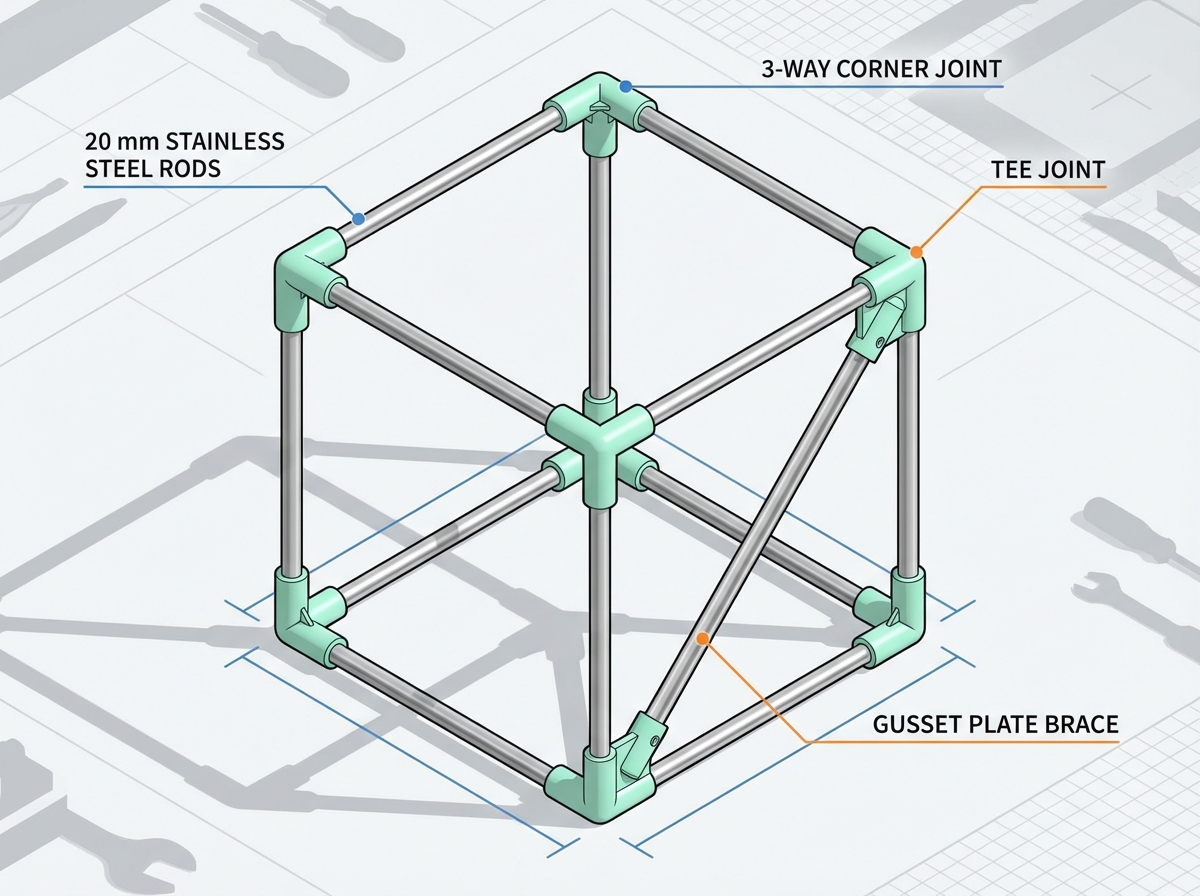
Anatomy of a basic cube made from plastic joints and 20 mm stainless rods.
Modular plastic joints with 20 mm stainless rods: applications and design guide
This article explores what you can build with modular plastic joints and 20 mm stainless rods, like the cube shown in your photo. You’ll find application ideas, pattern libraries for joints, quick build recipes, and light engineering tips so your frames are stiff, safe, and reconfigurable.
Why this system works
- Fast, tool‑light assembly and reconfiguration
- Corrosion‑resistant stainless rods; plastic joints tolerate wet and chemical-prone environments
- Scalable: repeatable modular lengths make gridding and nesting easy
- Hybrid-friendly: panels, casters, hinges, and accessories bolt directly to joints
Core components
- 20 mm round stainless rods or tubes (304/316): cut to standard module lengths (for example 250, 500, 750, 1000 mm)
- Plastic joints: 3-way corners, tees, crosses, 5-/6-way nodes, hinges, foot pads, and end plugs
- Fastening methods: compression sockets, set screws, through-bolts, cross-pins, or collars
- Add-ons: diagonal braces, gusset plates, caster plates, panel clips, threaded inserts, anchor feet
Application ideas (with notes)
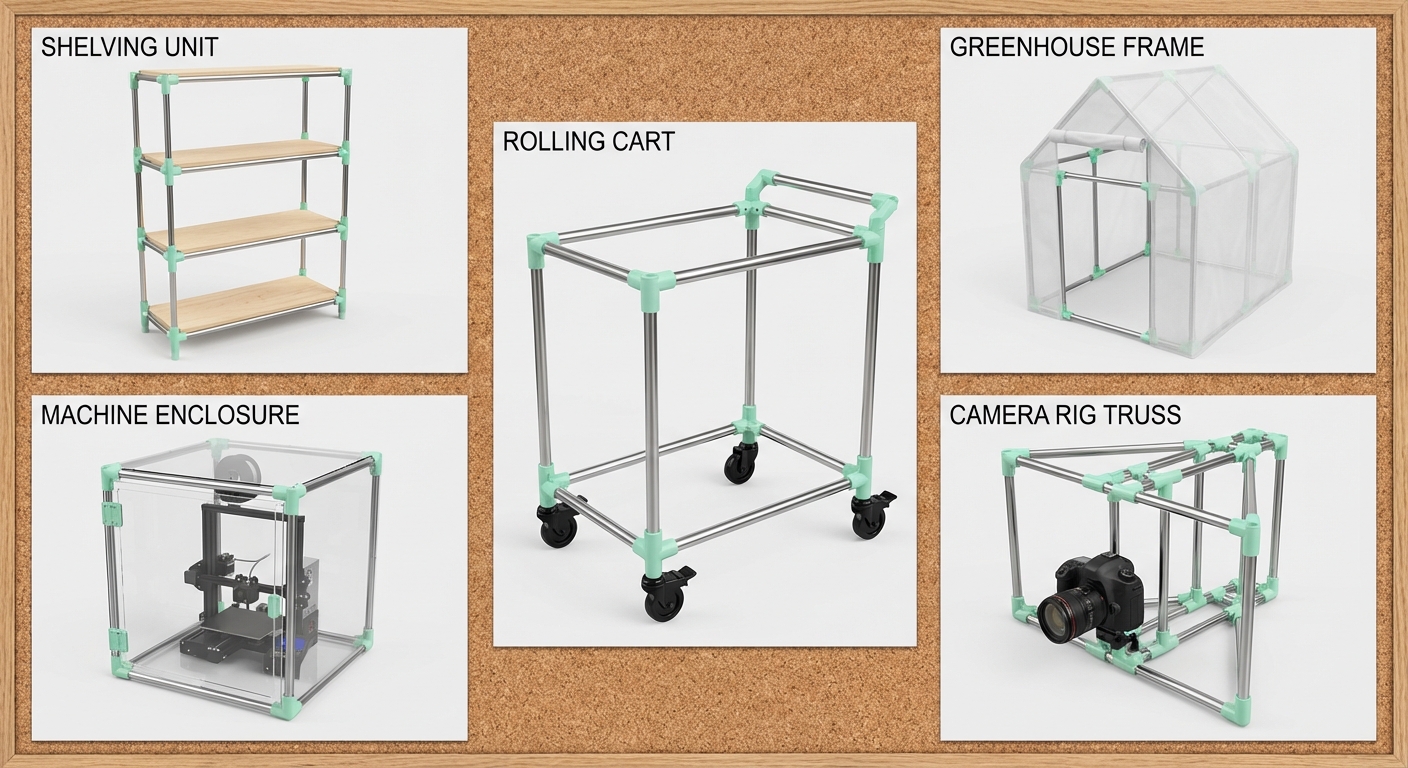
- Utility shelving and workbenches
- 3D grid cubes with plywood or composite shelves sitting on perimeter rods
- Add diagonal bracing on rear and sides to stop racking; use gusset plates at corners
- Light machine enclosures and safety guards
- Frame + clear polycarbonate panels clipped to rods; use hinges for access doors
- Choose ASA/PC joints for better heat and UV resistance near equipment
- Mobile carts and trolleys
- 2-tier or 3-tier frames with caster plates on the base nodes
- Use stainless tube to save weight; add cross-braces under each shelf
- Electronics/AV racks and printer enclosures
- Sized to standard equipment widths; cable trays zip-tie to rods
- Snap-in vibration isolators for sensitive devices
- Greenhouses, seedling tables, and aquaponics frames
- Moisture- and fertilizer-resistant; add tie-bars every 1 m to cut deflection
- Anchor feet with ground stakes or concrete screws
- Pop-up trade-show booths and retail displays
- Reconfigurable bays; magnet-backed graphic panels on thin steel strips
- Corner lighting spigots clamp onto rod intersections
- Camera rigs and lighting grids
- 3D truss cages; use swivel joints for boom arms and adjustable heads
- Sports and maker fixtures
- Bike stands, kayak cradles, RC test benches, climbing-wall volumes (with plywood skins)
- Temporary shelters and sun canopies
- Triangulated roof panels; use fabric skins that lace around the rods
- For wind loads, add storm lines at node eyelets
- Robotics, test rigs, and material handling
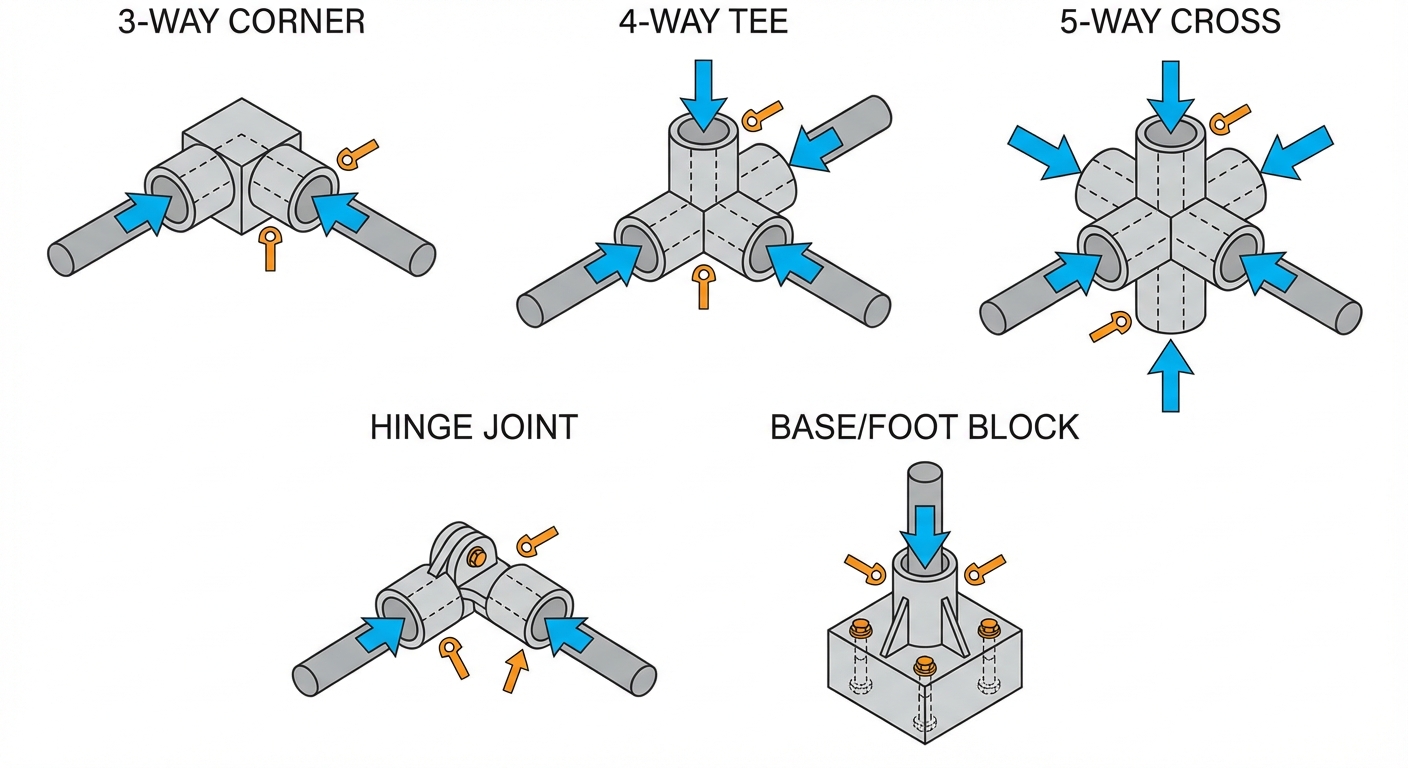
Common joint types and how rods fasten into them.
One kit, many builds: from carts to enclosures and greenhouses.
- Linear guides and sensors mount via printed clips
- Swap modules as test articles change
Pattern library: joints and how to use them
- 3-way 90° corner: for cubes and frames; accepts vertical and two orthogonal horizontals
- 4-way tee: extend frames in one plane; great for shelving mid-nodes
- 5-way cross: build space frames and diagonals through the node
- Adjustable hinge/rotule: camera booms, doors, folding structures
- Base/foot block: caster plates, floor anchors, levelers
- Panel clip: accepts 3–6 mm sheets; quick-release for maintenance
Tip: Wherever possible, push at least one diagonal through each rectangular bay; triangles beat rectangles for rigidity.
Quick build recipes
- Shelf cube (600 mm): 12 rods @ 600 mm + 8 corner joints + 2 rear diagonals + 4 feet. Load: 40–80 kg per shelf with plywood skins and rear/side bracing.
- Rolling AV cart (800×500×900 mm): 14 rods + 4 tees + 8 corners + 4 caster plates + 2 shelves. Add a push handle using two tees and a top crossbar.
- Printer enclosure (700 mm): 12 rods + 8 corners + door hinges + magnetic latch; seal gaps with silicone edge gaskets.
- Greenhouse bay (1,000×1,000×1,800 mm): 20 rods + 8 corners + 6 tees + roof diagonals; skin with UV poly film and clip strips.
Light engineering: sizing for 20 mm stainless rods
- Material: 304/316 stainless; modulus of elasticity ≈ 193 GPa
- Buckling (axial compression), pinned ends: Pcr ≈ π²·E·I / L²
- 20 mm solid rod: I ≈ 7.85×10⁻⁹ m⁴ → at L = 1.0 m, Pcr ≈ 15 kN (≈ 1,500 kgf) ideal
- 20 mm tube, 1.5 mm wall: I ≈ 3.75×10⁻⁹ m⁴ → at L = 1.0 m, Pcr ≈ 7.1 kN (≈ 725 kgf) ideal
- Real-world practice: derate by 2–4× for imperfections, joints, and eccentric loading; bracing every 0.5–1.0 m drastically increases capacity.
- Bending: treat each panel as a beam; span/deflection improves ~L³ with added mid-span ties.
- The plastic joint is usually the weak link. For printed nylon or ABS, assume 100–300 N clamp friction per socket without through-bolts; with cross-bolts and gussets, 1–2 kN per joint is achievable. Test a single bay before committing.
Materials and environment
- Indoors: PLA+ for prototypes; ABS/ASA for heat; PETG for impact; nylon or CF‑nylon for high strength
- Outdoors: ASA or UV-stabilized PC; stainless 316 near saltwater
- Chemicals: check compatibility charts for cleaners and oils; add replaceable liners inside sockets
Assembly and connection tips
- Use color-coded joints for fast field assembly
- Add numbered collars to rods to preserve cut inventory
- Through-bolt critical nodes; use nyloc nuts and serrated washers
- Add removable diagonal braces with quick pins
- Use panel clips or U-channel gaskets to mount sheets without rattle
Cost and reuse
- Standardize on 250 mm modules to minimize offcuts
- Design for teardown: no adhesives on primary nodes
- Keep a “conversion kit” of hinges, caster plates, and diagonals to repurpose frames seasonally
Getting started checklist
- Define the module: e.g., 500 mm grid, 20 mm rods
- Choose joint family and fastening method
- Sketch bays and place diagonals
- Estimate loads; check longest unbraced member for buckling; add braces if needed
- Prototype one bay and load test to at least 1.5× expected service load
- Document the cut list and label parts for repeat builds
With a small bin of joints and 20 mm rods, you can assemble stiff, clean-looking frames that adapt to workshops, labs, retail, and outdoors—without committing to permanent weldments.
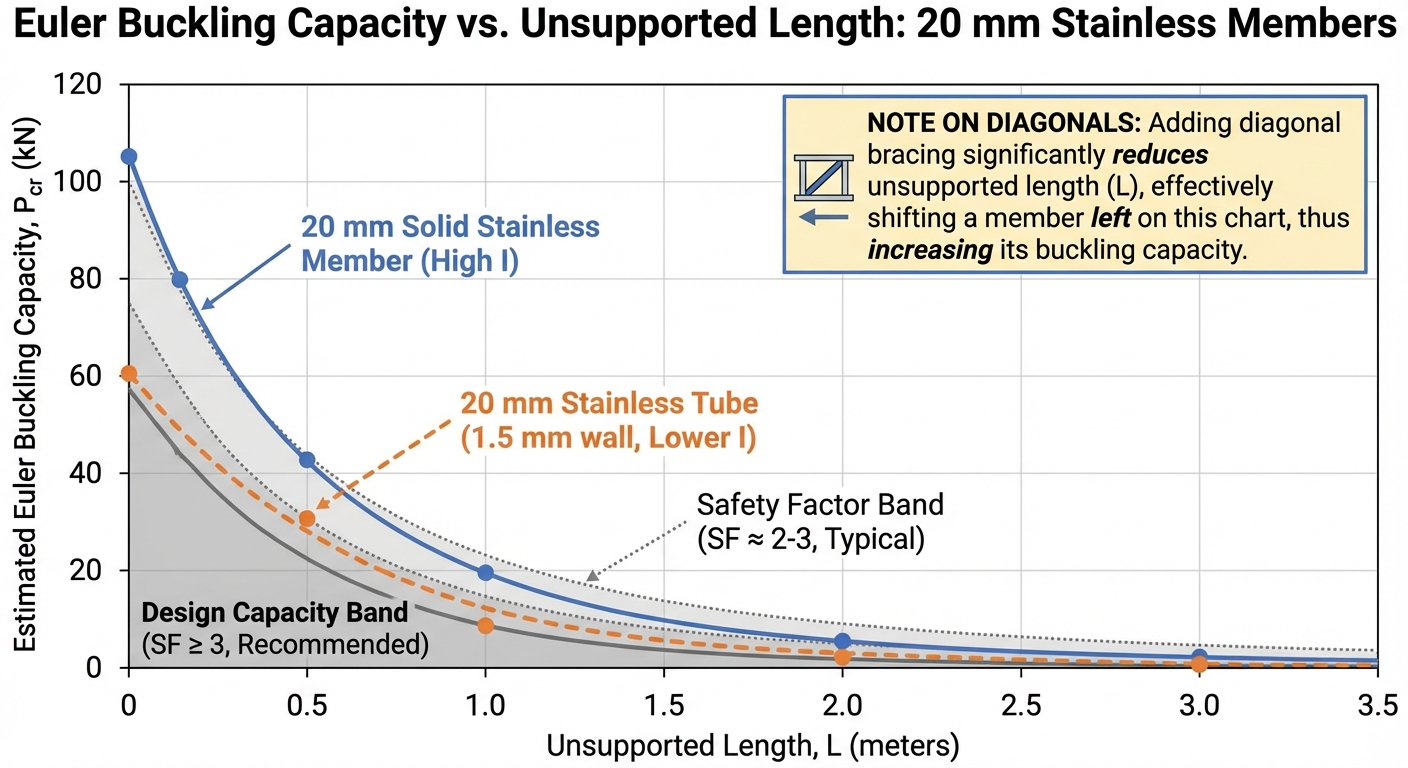
Rule of thumb: brace long members or use thicker walls to push buckling loads up.
References, example projects, and off‑the‑shelf parts (Amazon, McMaster‑Carr, and others)
Use these catalogs, project links, and product picks to source 20 mm components and accessories for the joint/rod system.
References and vendor catalogs (tube connectors and accessories)
- JW Winco tube clamp connectors (aluminum, stainless, and plastic families) with 20 mm bores and adapters. (jwwinco.com)
- JW Winco split‑assembly tube connector joints (GN 241) and base plate clamps (GN 163) for posts, feet, and plates. (jwwinco.com)
- Elesa+Ganter technopolymer tube connectors (12–30 mm range; hinges and clamps; PA+stainless hardware). (elesa-ganter.com)
- KIPP plastic tube clamps (straight, base/foot, swivel, T‑angle). Reducer sleeves allow adapting to other diameters. (kipp.at)
- JW Winco panel support clamps (EN 649 plastic; GN 939 die‑cast) and adapters for mounting panels to round tubes. (jwwinco.com)
Example projects and printable parts (ideas and patterns)
- Telescoping tube clamps (DIY tutorial with brazed clamp pads and screw draw). (instructables.com)
- 3D‑printable 20 mm conduit/pipe clips and joints: T‑joints, 3‑way connectors, end caps, adapters. Useful for quick fixtures and panel clips. (makerworld.com)
Off‑the‑shelf hardware by category
20 mm stainless rods and tubes
- Ground/polished metric stainless rotary shafts (304/303) in 20 mm; multiple lengths (McMaster). Solid rods are ideal for high clamp friction and stiffness. (mcmaster.com)
- 20 mm stainless conveyor guide mounting rods (hollow options; lightweight, marked). (mcmaster.com)
- 316 stainless keyed shafts in 20 mm (Zoro; useful where keyed stops/collars are desired). (zoro.com)
Plastic/metal tube connectors and bases (20 mm and adapters)
- JW Winco two‑way/base/swivel connector clamps (20 mm bores available). (jwwinco.com)
- KIPP thermoplastic tube clamps (straight, base/foot, swivel, T‑angle) with reducer sleeves to adapt smaller/larger tube sizes. (kipp.at)
Collars, stops, and adjustable hardpoints (20 mm)
- Ruland 20 mm shaft collars (one‑piece and two‑piece, 303 SS). Great as positive stops, panel stand‑offs, or bracket anchors. (ruland.com)
- McMaster clamping/quick‑connect collars and wrench‑flat collars (fast repositioning, non‑marring). (mcmaster.com)
Linear motion (when you want sliding doors, drawers, or camera booms)
- LM20UU linear ball bearings (20 mm ID) and equivalents; pair with 20 mm shafting for guided slides. Available from multiple vendors. (ato.com)
- Shaft collars (above) double as travel stops and carriages.
Panel mounting to rods and hinges/latches
- Panel support clamps (EN 649 plastic) plus adapter EN 649.1 to clamp 3–8 mm sheet directly to round tubes; GN 939 clamps for heavier glass/plastic panels. (jwwinco.com)
- Plastic lift‑off and friction hinges (nylon/acetal with stainless pins) for light doors and access hatches (McMaster). (mcmaster.com)
- Magnetic push/touch latches (stainless options; push‑to‑open, no handle). (mcmaster.com)
Casters and base plates
- Caster mounting plates/sockets (for stem or plate casters) to adapt base nodes. (mcmaster.com)
- Stainless workhorse casters (4 in plate‑mount) for wet/food/chem environments. (accesscasters.com)
Panel materials and edge treatments
- Clear/UV‑resistant polycarbonate sheets (cut‑to‑size) for guards and enclosures; corrugated roof/siding panels for greenhouses. (mcmaster.com)
- U‑channel edge seals/trim and panel edge grips to seat 3–6 mm sheets rattle‑free. (mcmaster.com)
Bracing, gussets, and joining plates
- Stainless/steel corner brackets and gusset plates to add triangles and tie panels to nodes. (mcmaster.com)
Greenhouse skins and clips (fits 18–20 mm OD)
- Snap/spring clamps for holding film or shade cloth to round tube/conduit (select the size that matches 18–20 mm OD). (greenhousemegastore.com)
Quick‑release/teardown hardware
- Detent/quick‑release pins and receptacles (metric diameters) for removable diagonals and accessories. (mcmaster.com)
- Threaded quick‑release pins and double‑locking styles for higher loads. (mcmaster.com)
Threaded inserts for plastic joints (3D‑printed or molded)
- Heat‑set brass inserts (assortments and M‑series sizes) to upgrade sockets to bolt‑through strength. (mcmaster.com)
Vibration isolation
- Cylindrical isolation mounts and vibration‑damping grommets (choose stainless hardware where needed). (mcmaster.com)
Fasteners that hold in the field
- M6 stainless nylon‑insert (DIN 985) or all‑metal locknuts, plus serrated/wedge‑lock washers for joints subject to vibration. (mcmaster.com)
Notes for Amazon sourcing
- Typical search terms that map well to this system: “20mm shaft collar stainless two‑piece,” “LM20UU linear bearing,” “20mm stainless round bar,” “greenhouse snap clamp 20mm,” “M6 stainless nyloc nut.” Confirm dimensions and tolerances—20 mm is 0.787 in; some “3/4 in” hardware (19.05 mm) will be too loose for precision joints.
Fit and selection tips
- Tube vs. solid: 20 mm solid rod maximizes clamp friction and stiffness; thin‑wall tube cuts weight but may dent under high clamp loads—add sleeves or through‑bolts at critical nodes. Use keyed or D‑profile shafting where anti‑rotation is required. (mcmaster.com)
- Connector families vary by nominal size; many plastic clamp systems offer reducer sleeves to fit 20 mm within an 18/30 mm family. Check the vendor’s accessory list. (kipp.at)
- For panels, choose UV‑resistant polycarbonate outdoors and add U‑channel edge seals to avoid buzz and chafe. Corrugated polycarbonate panels simplify roof spans and shed water. (mcmaster.com)
If you want, I can turn any of your “Quick build recipes” into a one‑click bill of materials with specific part counts and SKUs from McMaster (and Amazon alternatives).