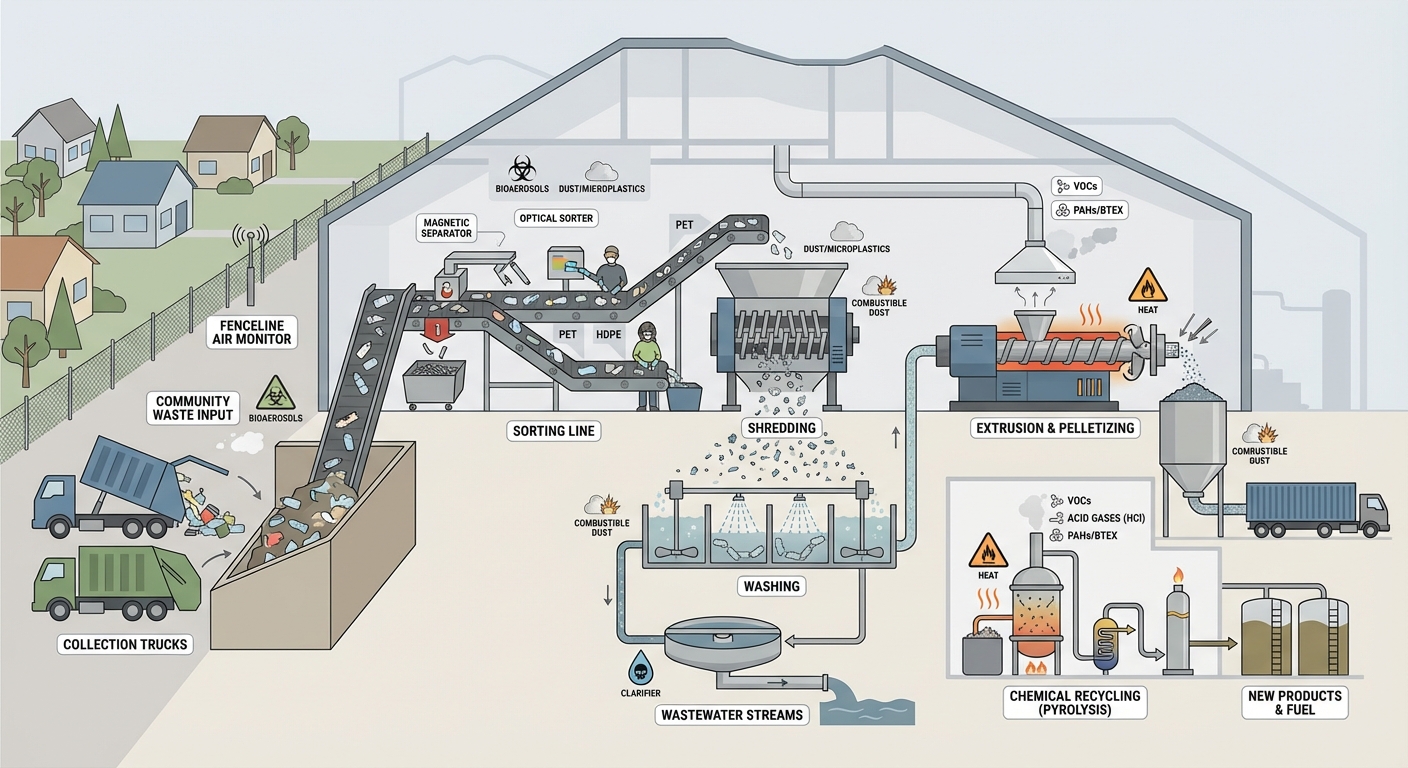
At-a-glance map of exposures across the recycling system.
Health Impacts of Plastic Recycling
A practical, evidence-based guide to who is exposed, what the hazards are, how to control them, and where to find trustworthy resources.
Table of Contents
- Chapter 1 — Why Health Matters in Plastic Recycling
- Chapter 2 — Who Is Exposed and How
- Chapter 3 — Process-Specific Hazards
- Chapter 4 — Health Outcomes: What the Evidence Shows
- Chapter 5 — Risk Mitigation and Best Practices
- Chapter 6 — Policy and Regulatory Landscape (Selected)
- Chapter 7 — Data Gaps and Research Priorities
- Chapter 8 — Practical Checklists
- Chapter 9 — Links and Resources
- Chapter 10 — Key Takeaways
Chapter 1 — Why Health Matters in Plastic Recycling
- Plastic recycling reduces demand for virgin plastics and can cut greenhouse gas emissions, but it also introduces worker, community, and consumer health risks if not well controlled.
- Key risk drivers: mixed and contaminated feedstocks, thermal processing, dust and microplastics, additive chemicals, inadequate emission/wastewater controls, and fires/explosions.
What’s different about plastics? They are complex mixtures of polymers, residual monomers, and additives (plasticizers, flame retardants, stabilizers) that can transform under heat and mechanical stress, creating diverse exposure profiles in recycling compared to other materials.
Chapter 2 — Who Is Exposed and How
- Workers
- Collection and sorting: bioaerosols, dust, sharp objects, noise, diesel exhaust.
- Shredding/washing: microplastic dust and fibers, detergents/solvents, wastewater contaminants.
- Extrusion/pelletizing: heat stress, volatile organic compounds (VOCs), ultrafine particles, combustible dust.
- Chemical recycling (pyrolysis/gasification/depolymerization): hot oils, PAHs, BTEX, acid gases, catalyst residues, flares.
- Informal waste pickers: high exposures with minimal controls; additional injury and psychosocial risks.
- Manufacturers of recylcing equipment: extreme risks on a daily basis, exposed to severe and fatal injuries but also long term implications from welding, dust, etc...
- Nearby communities
- Young and uninformed people, see Precious Plastic Scam specifically targeting people with false claims, immature machines.
- Air emissions (VOCs, odors, particulate), noise, traffic, fire/smoke, stormwater and wastewater discharges.
- Consumers
- Additives and contaminants migrating from recycled materials (especially food-contact applications).
- General population and environment
- Microplastics and additive chemicals in air, water, soil; open burning of plastics in some contexts.
Mental health impacts deserve a dedicated article.
Chapter 3 — Process-Specific Hazards
- Collection/sorting
- Bioaerosols and pathogens from commingled waste; ergonomic injuries; noise; vehicle exhaust.
- Shredding/washing
- Airborne microplastics and dust; cleaning agents; wastewater containing additives, heavy metals, flame retardants.
- Mechanical recycling (melting/extrusion/pelletizing)
- Thermal degradation products:
- PET: acetaldehyde; antimony migration risk from catalysts.
- PS: styrene; other aromatics.
- Mixed streams: aldehydes, organic acids, VOCs; PVC contamination can release HCl and drive corrosive/acidic emissions.
- Ultrafine particles; heat stress; combustible dust and fire/explosion hazards.
- Thermal degradation products:
- Chemical recycling
- Pyrolysis/gasification oils and gases can contain PAHs and BTEX; potential formation of dioxins/furans if halogenated plastics are present or during poor combustion.
- Fugitive emissions, flaring, benzene/styrene in off-gases, residual char handling.
- Streams with legacy hazardous additives
- E-waste plastics often contain brominated flame retardants (e.g., PBDEs) and antimony; risk of contaminating recycled streams and consumer products.
Chapter 4 — Health Outcomes: What the Evidence Shows
- Occupational health
- Respiratory: chronic cough, bronchitis/asthma from dust and fumes; reactive airway irritation.
- Neurological and sensory: headache, dizziness, eye/skin irritation linked to solvents and styrene.
- Reproductive/endocrine: certain phthalates, BPA, and brominated flame retardants are associated with endocrine and reproductive effects; relevance depends on exposure levels and controls.
- Injuries: cuts, needlesticks, musculoskeletal disorders; heat stress.
- Fire/explosion incidents: smoke inhalation, burns; community impacts from plume.
- Community health
- Short-term: odors, irritation, noise, traffic safety; acute smoke exposure during fires.
- Long-term: limited but growing epidemiology on proximity to recycling/waste facilities; risk depends on emissions control and siting.
- Consumers and recycled food-contact materials
- With approved decontamination processes (e.g., rPET), migration into food is generally within regulatory limits; poor-quality or noncompliant recycling can increase risk.
- Microplastics and human health
- Microplastic particles have been detected in human blood and lung tissue; current evidence points to potential inflammatory responses, especially for particles <10 μm, but health effects at environmental exposures remain uncertain and under active study.
Studies and reviews (examples):
- WHO: Microplastics in drinking-water (2019) and subsequent updates — https://www.who.int/health-topics/microplastics
- Plastic particles in human blood (Environment International, 2022) — https://www.sciencedirect.com/science/article/pii/S0160412022001258
- Microplastics detected in human lung tissue (Science of the Total Environment, 2022) — https://www.sciencedirect.com/science/article/pii/S0048969722011828
Chapter 5 — Risk Mitigation and Best Practices
- Engineering and environmental controls
- Enclose and local exhaust ventilate (LEV) shredders, hoppers, and extruders; capture and filter (HEPA where applicable).
- Temperature control and residence time optimization to minimize thermal degradation.
- Combustible dust management: housekeeping, dust collection, spark detection/suppression, explosion venting/relief; follow NFPA/ATEX guidance.
- Wastewater pretreatment for solids, microplastics, and chemical additives; closed-loop wash water where feasible.
- Real-time monitoring for dust (PM), VOCs, temperature, and flammable gases; audible/visible alarms.
- Administrative controls and PPE
- Task-based exposure assessments; job rotation; maintenance lockout/tagout.
- PPE: cut-resistant gloves, eye protection, hearing protection, respirators where warranted (fit-tested); heat stress prevention programs.
- Vaccination and biohazard protocols for workers handling mixed MSW.
- Safer inputs and design
- Pre-sorting to exclude PVC and brominated materials; supplier declarations; screening technologies (NIR/XRF).
- Design for recycling: avoid substances of very high concern; select safer additives; traceability/digital product passports.
- Community protections
- Siting and buffer zones; fenceline air monitoring; stormwater controls; grievance and incident reporting mechanisms; transparent emissions data.
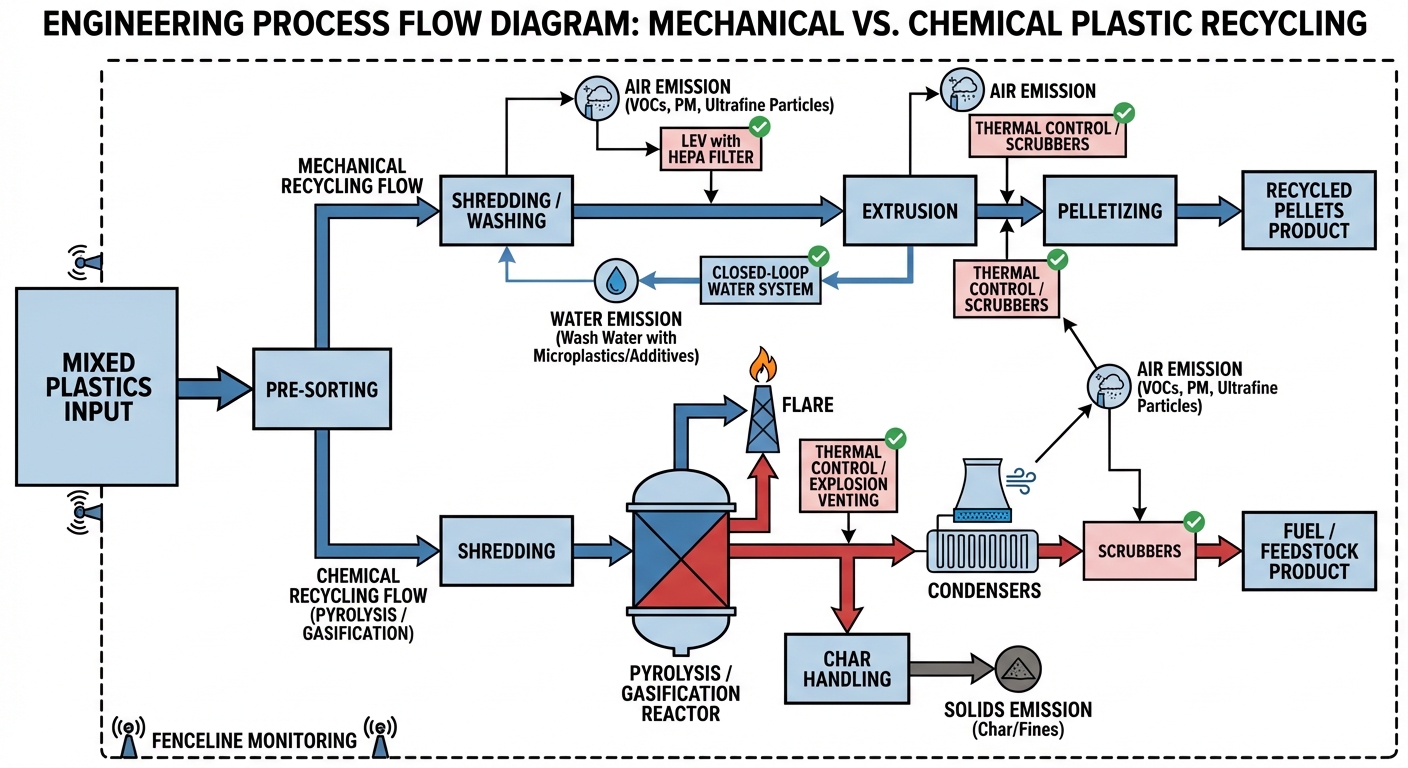
Key process-specific hazards and where to control them.
- Compliance and continuous improvement
- Implement ISO 45001 (worker safety) and ISO 14001 (environmental management); adopt BAT/BEP from regulatory BREF notes.
- Drill fire/emergency response with local authorities.
Chapter 6 — Policy and Regulatory Landscape (Selected)
- Global treaties and frameworks
- Basel Convention plastic waste amendments (controls transboundary movement) — https://www.basel.int/Implementation/Plasticwaste/PlasticWasteAmendments/Overview
- Stockholm Convention on POPs (e.g., PBDEs) — https://www.pops.int/
- UN Plastics Treaty (INC process) — https://www.unep.org/intergovernmental-negotiating-committee-plastic-pollution
- Chemicals and product controls
- ECHA microplastics restriction (EU, 2023) — https://echa.europa.eu/hot-topics/microplastics
- ECHA Candidate List (SVHCs) — https://echa.europa.eu/candidate-list-table
- EFSA opinion lowering BPA TDI (2023) — https://www.efsa.europa.eu/en/news/efsa-lowers-tolerable-daily-intake-bisphenol-bpa
- Food-contact recycled plastics
- EU: Commission Regulation (EU) 2022/1616 on recycled plastics for food contact — https://eur-lex.europa.eu/eli/reg/2022/1616/oj
- EFSA topic page on plastics recycling — https://www.efsa.europa.eu/en/topics/topic/plastics-recycling
- US FDA: Recycled plastics in food packaging (No Objection Letter process) — https://www.fda.gov/food/packaging-food-contact-substances-fcs/recycled-plastics-food-packaging
- Occupational safety and fire/explosion
- ATEX (explosive atmospheres) overview — https://osha.europa.eu/en/themes/dangerous-substances/explosive-atmospheres-atex
- NFPA combustible dust resources — https://www.nfpa.org/combustibledust
- NIOSH on styrene — https://www.cdc.gov/niosh/topics/styrene/default.html
- CDC/NIOSH heat stress — https://www.cdc.gov/niosh/topics/heatstress/
Chapter 7 — Data Gaps and Research Priorities
- Exposure characterization for workers in different recycling configurations, including chemical recycling.
- Fate and transport of microplastics and additives through wastewater and air from facilities.
- Longitudinal community health studies near recycling plants and in regions with open burning.
- Safe thresholds and modes of action for micro- and nanoplastics in humans.
- Practical detection and control strategies for legacy hazardous additives in recyclate streams.
Chapter 8 — Practical Checklists
Facility operators
- Conduct a process hazard analysis (PHA) and combustible dust hazard analysis (DHA).
- Install LEV on shredders/extruders; maintain capture velocities; verify with smoke tests.
- Implement real-time PM/VOC monitoring and preventative maintenance for filters.
- Segregate and exclude PVC, brominated plastics, and unknown black plastics unless screened.
- Treat wash water; capture and dispose of fines; verify effluent quality.
- Train on PPE, heat stress, lockout/tagout, spill response, and fire drills.
Community and local authorities
- Require emissions inventories, wastewater permits, and public reporting.
- Establish buffer zones; require fenceline monitoring and complaint tracking.
- Plan joint emergency response for fires, spills, and smoke events.
- Audit waste acceptance and contamination controls, especially for e-waste plastics.
Consumers and purchasers
- Prefer certified recycled content from audited, food-contact-compliant processes where relevant.
- Avoid products likely made from mixed e-waste plastics (unless certified free of POPs/BFRs).
- Support reuse/refill systems to reduce overall plastic throughput.
Chapter 9 — Links and Resources
Global overviews and reports
- WHO — Microplastics: health evidence and guidance — https://www.who.int/health-topics/microplastics
- UNEP — Turning off the Tap (2023) — https://www.unep.org/resources/report/turning-tap
- OECD — Global Plastics Outlook — https://www.oecd.org/environment/plastics/plastics-outlook/
Regulatory/technical guidance
- EFSA — Plastics recycling (food contact) — https://www.efsa.europa.eu/en/topics/topic/plastics-recycling
- US FDA — Recycled plastics in food packaging — https://www.fda.gov/food/packaging-food-contact-substances-fcs/recycled-plastics-food-packaging
- EU BREF — Best Available Techniques for Waste Treatment — https://eippcb.jrc.ec.europa.eu/reference/waste-treatment
- ECHA — Microplastics restriction — https://echa.europa.eu/hot-topics/microplastics
- Stockholm Convention — Persistent Organic Pollutants — https://www.pops.int/
- Basel Convention — Plastic waste amendments — https://www.basel.int/Implementation/Plasticwaste/PlasticWasteAmendments/Overview
Occupational health and safety
- NIOSH — Styrene topic page — https://www.cdc.gov/niosh/topics/styrene/default.html
- NFPA — Combustible dust resources — https://www.nfpa.org/combustibledust
- UK HSE — Managing risks from dust — https://www.hse.gov.uk/dust/
- ISO 45001 (OHS management) — https://www.iso.org/iso-45001-occupational-health-and-safety.html
- ISO 14001 (environmental management) — https://www.iso.org/iso-14001-environmental-management.html
Community data and monitoring tools
- US EPA — ECHO (facility compliance and emissions) — https://echo.epa.gov/
- US EPA — TRI (Toxics Release Inventory) — https://www.epa.gov/toxics-release-inventory-tri-program
- EU — Industrial Emissions Portal — https://industry.eea.europa.eu/industrial-pollution/industrial-emissions-portal
- OpenAQ — Global air quality data — https://openaq.org/
Peer-reviewed evidence and databases
- Microplastics in human blood (2022) — https://www.sciencedirect.com/science/article/pii/S0160412022001258
- Microplastics in human lung tissue (2022) — https://www.sciencedirect.com/science/article/pii/S0048969722011828
- PubMed search: plastic recycling workers respiratory — https://pubmed.ncbi.nlm.nih.gov/?term=plastic+recycling+workers+respiratory
- WHO — Dioxins and health — https://www.who.int/news-room/fact-sheets/detail/dioxins-and-their-effects-on-human-health
Civil society and technical briefs (for deeper context)
- IPEN — Toxic recycling (legacy POPs in recycled plastics) — https://ipen.org/documents/toxic-recycling
Chapter 10 — Key Takeaways
- Well-managed recycling protects workers and communities while enabling circularity; poorly controlled operations can emit hazardous substances and microplastics.
- Priority actions: robust engineering controls, exclusion of hazardous feedstocks, validated decontamination for food-contact, transparent monitoring/reporting, and community engagement.
- Policies that pair upstream design-for-safety with downstream best-available techniques deliver the greatest health benefit.
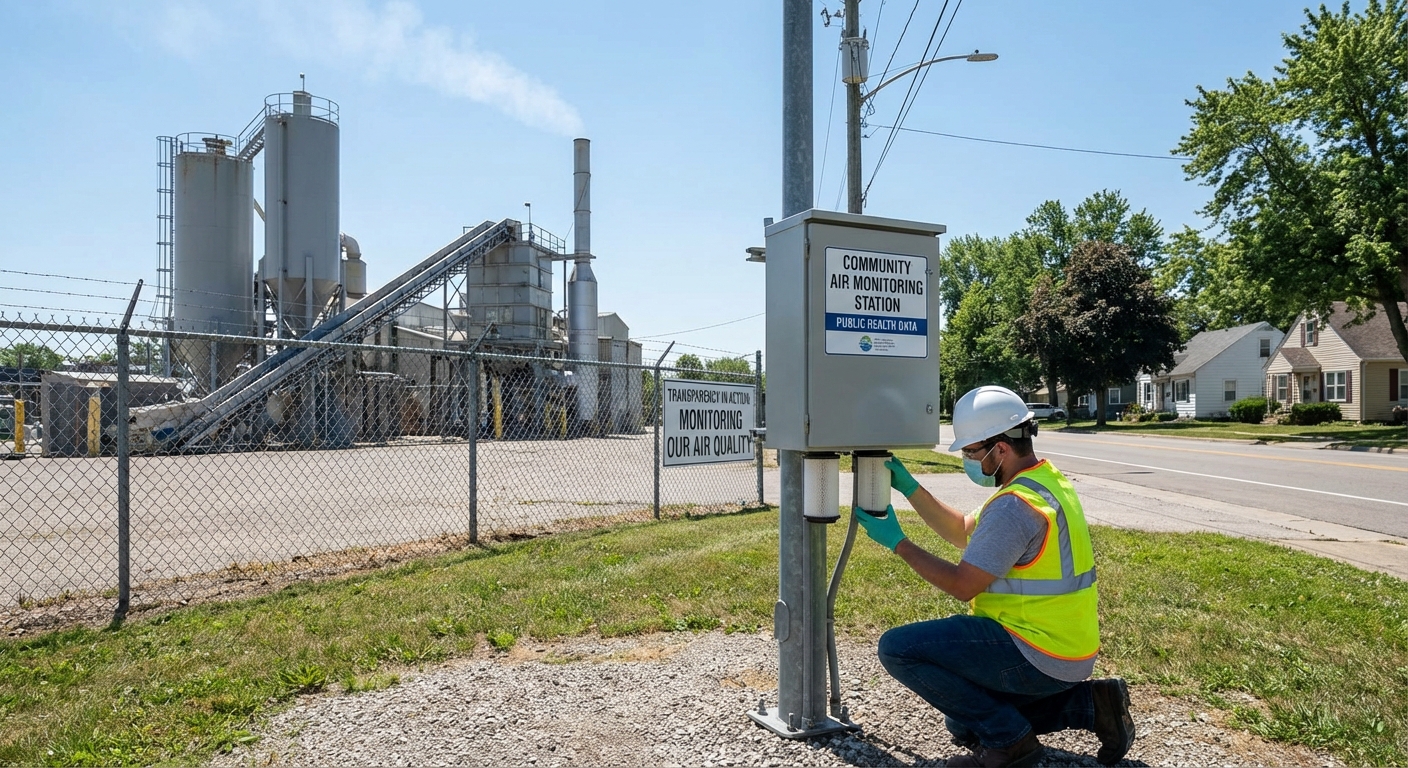
Community protections include siting, monitoring, and transparent reporting.
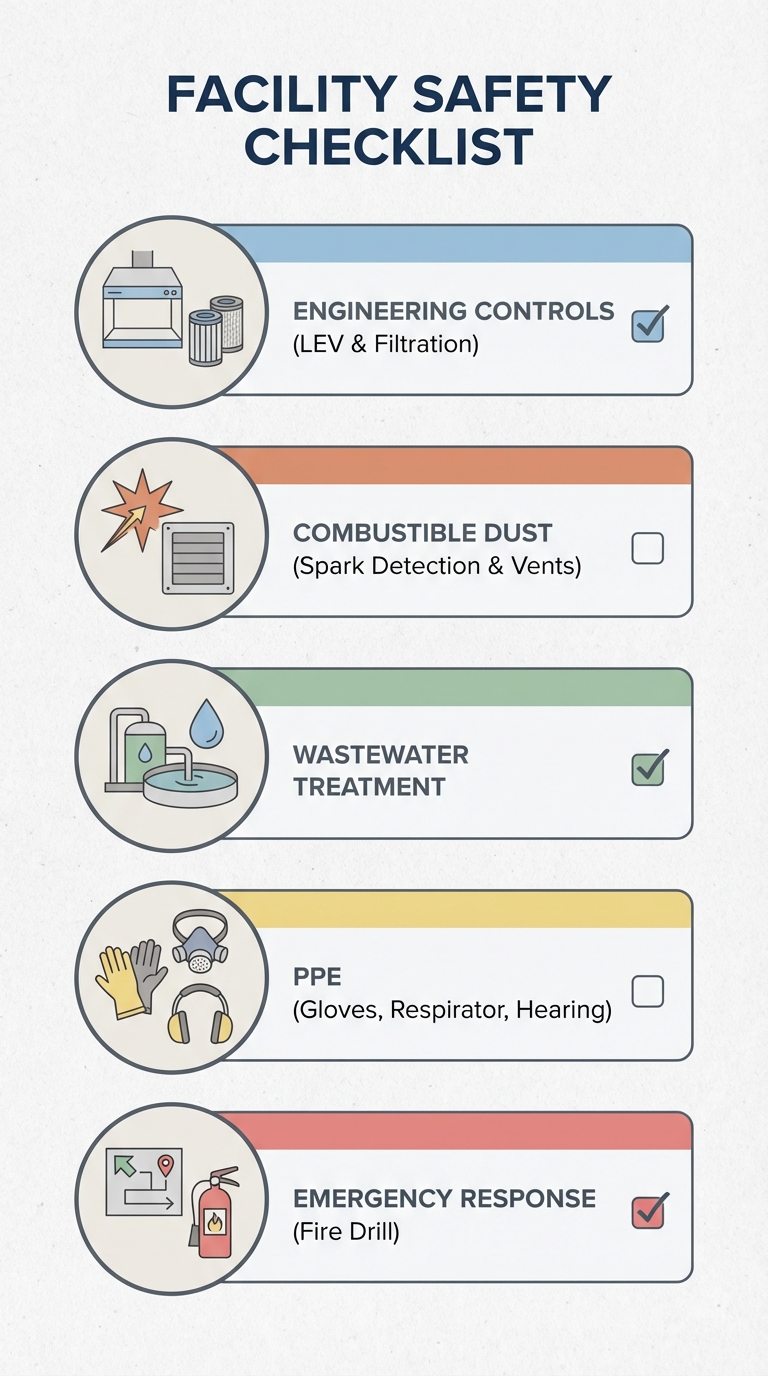
Quick-reference controls for operators and safety teams.